
A bachelor’s degree may be enough to get you started in the financial sector, but a master’s in finance or business administration may help you advance into more senior roles, the BLS reports. Financial analysts perform many important duties in a variety of organizations across industries. Some of their most common tasks include recommending investments and portfolios to investors, evaluating financial data, studying economic trends, examining financial records, and preparing written reports.
- Evaluate and analyze capital expenditures, depreciation, proposals, investment opportunities, rate of return, profit plans, operating records, financial statements, etc.
- A good financial analyst is not only good with numbers but actually generates insights and recommendations on how to improve the operations of a business.
- In securities and IB roles, it is lately preferred that, similarly, even to enter, analysts earn a master’s or the CFA designation – in Europe, the CIIA also – with the MBA still common at senior levels.
- While junior to intermediate level FP&A analysts consolidate data and build financial models, senior FP&A analysts and FP&A managers are in charge of business forecasting and planning.
- Some analysts travel to visit potential investors, potential investments, and perform hands-on evaluations that enable them to accurately decide the value and potential risk of each investment.
Unless you’re a professional with 15+ years of experience, chances are, you don’t need more than a single page. The format starts off with the most recent work experiences and then goes backward in time. Since the candidate has a lot of work experience, they don’t focus as much on their educational history.
Types of financial analysts
The offers that appear in this table are from partnerships from which Investopedia receives compensation. Investopedia does not include all offers available in the marketplace. A bachelor’s degree in a math or finance-related major is often sought. Typical level of education that most workers need to enter this occupation.
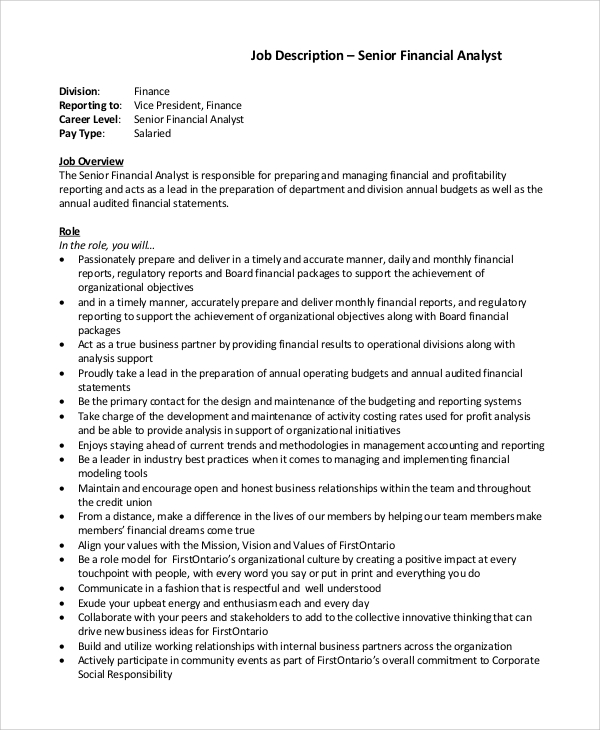
Financial analysts, employed by banks or pension funds, will then help businesses and individuals in choosing what investment strategy to employ to ensure their money is working for them. Additionally, you can gain a significant amount of experience during your studies by obtaining an education that values hands-on learning through real-world experiences. Experiential learning programs like those offered at Northeastern, for example, can allow for professional networking opportunities and collaboration with industry leaders on a consistent basis. This connected network can help keep you up-to-date on the latest trends, challenges, and possible solutions in today’s ever-changing, modern financial world. Most importantly, however, you likely want to know what steps you can take today that will help you land a role in this lucrative field. Below, we explore what financial analysts do, as well as offer some guidance for aspiring financial analysts hoping to define their careers and set themselves up to be leaders in the modern financial world.